Pneumatic handling components are devices that grip, lift, orient, transfer, or hold parts in automated production and assembly processes. They include pneumatic grippers, vacuum suction cups, rotary actuators, and material transfer units. Pneumatics Group Ireland distributes Metal Work and Gimatic handling components with technical support and fast delivery from Dublin.
Dropping a product on a packaging line. Scratching a precision part during transfer. Struggling to integrate grippers with a new cobot arm. These are the day-to-day headaches facing automation engineers in Irish factories and they all start with the wrong handling component.
Whether you’re automating a pick-and-place cell, building an end-of-arm tool for a robot, or designing a conveyor transfer system, Pneumatics Group supplies the handling components to do it right from Ireland’s most comprehensive pneumatics stock.
Handling components are the “hands” of an automated system. They physically interact with parts or products gripping, lifting, turning, or holding them in position. In pneumatic systems, compressed air powers the gripping or clamping action, providing fast, repeatable, and high-force handling without electric motors.
Type | How It Works | Typical Application |
Parallel Grippers | Two jaws move inward/outward to grip | Pick-and-place, assembly, machining |
3-Jaw Grippers | Three jaws close radially on round parts | Turning centres, cylindrical part handling |
Vacuum Suction Cups | Vacuum creates suction on flat/curved surfaces | Glass handling, food packaging, electronics |
Rotary Actuators | Rotate a part through a defined angle | Orienting parts before assembly |
Manipulators | Multi-axis arm for complex repositioning | Heavy part transfer, ergonomic lifting |
Angular Grippers | Jaws swing open/close at an angle | Tight-space assembly cells |
A gripper that’s undersized drops parts. One that’s oversized crushes them. The wrong surface material scratches polished components or slips on greasy ones. Poor jaw geometry means slower cycle times as robots wait for secure grip confirmation.
Our technical team helps you specify correctly by matching:
Metal Work is an Italian company specialised in the production of pneumatic components for automation systems. We currently market five different product ranges: actuators, valves, FRL units, fittings and handling components, all of which appear in our 1400 pages catalogue.
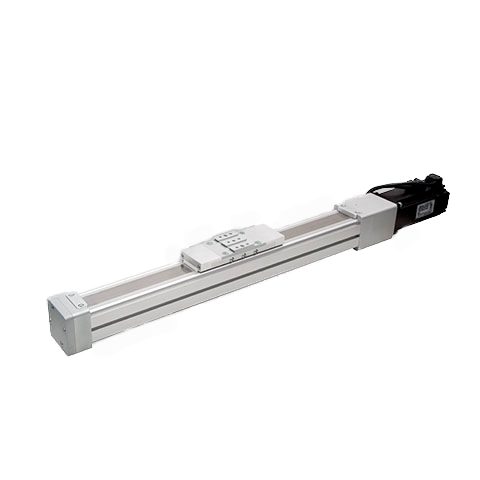
Electric axis without screw piston rod, with V-Lock interface.The cylinder frame is made of anodized extruded solid aluminium, which gives the cylinder optimal torsional and flexural rigidity. The typical V-Lockdovetail is provided on three sides of the channel for easy fixing with QSelements.The carriage features an interchangeable fixing interface plate, which isavailable with V-Lock axial or V-Lock orthogonal ports or in the blank typefor custom solutions.The carriage is driven by two sturdy pre-loaded ball recirculation bearingsthat ensure great accuracy of movement. Threaded holes for the lubrication of the guides and ball recirculationscrews are provided on both sides of the carriage.The carriage is driven by a system consisting of a hardened and temperedscrew and a ball recirculation lead nut. The screw is pre-stressed with anelastic load device by means of cup springs in order to reduce vibrationand hence noise level and the useful life of the system.A series of slots for the fixing of magnetic sensors are provided on the twosides of the liner.Various BRUSHLESS and STEPPING motor drives are available with optionalmotor brake and/or built-in encoder.The cylinder can also be supplied without motor drive or, on request, withmodules for interfacing with motors from the trade.The motors can be installed in line with the liner or geared using toothedbelt transmission gears
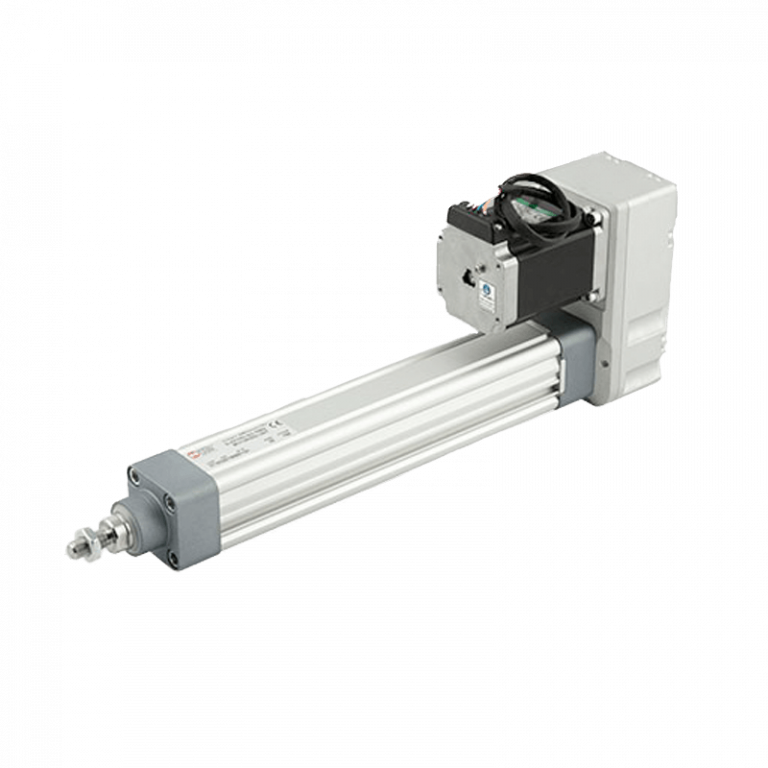
An electric cylinder with a connection interface in accordance with ISO 15552.The piston rod extension is controlled by a system with a hardened screw and recirculating ball screw nut. The piston has a guide strip calibrated to reduce to a minimum play with the barrel and hence vibration during ball screw rotation. The cylinder can be equipped with a built-in non-rotating system featuring two opposing slides that run in separate longitudinal slots in the barrel. The piston comes with magnets and the barrel has longitudinal slots for housing sensors. The piston rod has increased outside diameter and thickness to make it extra rigid and more resistant to radial and peak loads. A system for greasing the screws is included. Numerous standard accessories for pneumatic cylinders, can be used for mounting the cylinder. Accessories made of aluminium, or made of steel for heavy-duty operations, can be used.The motor can be selected from an optimised range, which encompasses both STEPPING and BRUSHLESS motors.
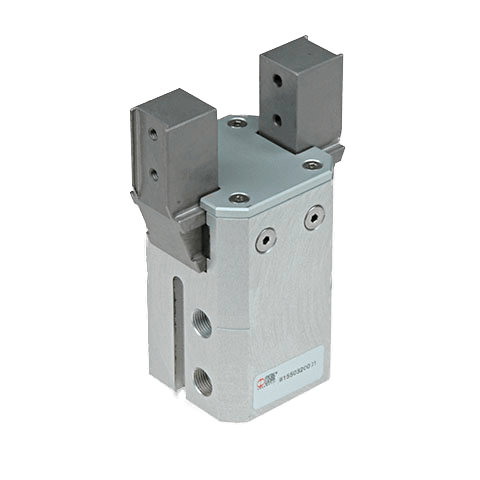
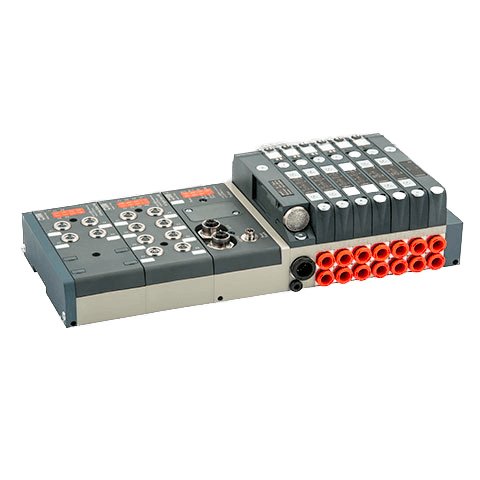
Pneumatic grippers use compressed air to close jaws around a part — ideal for rigid, irregularly shaped, or heavy components. Vacuum suction cups use compressed air to generate suction on a flat or slightly curved surface — ideal for sheets, panels, packaging, and smooth-surface products. Both are available from Pneumatics Group.
Yes. Many handling components from Metal Work and Gimatic are compatible with popular cobot platforms including Universal Robots, Fanuc, and KUKA. Contact us with your robot model and payload requirements for compatible options.
This varies by gripper type and bore size. Standard pneumatic parallel grippers in our range deliver gripping forces from under 10N up to 300N+. Contact us for high-force or custom applications.
Yes — we stock stainless steel and anodised aluminium grippers, FDA-compliant suction cup materials, and IP67-rated units for washdown environments.
Tell us your application – part weight, shape, cycle speed, and robot type and we’ll recommend the right handling component from stock.