

What Does ISO 8573-1 Class 1.4.1 Actually Mean?
ISO 8573-1:2010 grades compressed air purity with three numbers, in the order particles, water, oil. Class 1.4.1 therefore means Class 1 for solid particles, Class 4 for water (a pressure dew point of +3C), and Class 1 for oil (0.01 mg/m3 total). The three digits are independent classes, not a single grade, so each is read against its own column in the table below.
How do you read an ISO 8573-1 designation?
The designation always lists three purity classes in a fixed order: particles first, then water, then oil. A lower number is cleaner. So 1.4.1 is not better or worse than 1.2.1 overall; it is identical on particles and oil, and only differs on water. Reading each digit against its own class is the whole point of the standard.
Order matters: particles . water . oil. Mixing the order is the most common mistake, and it changes the spec completely. 1.4.1 and 1.1.4 are very different airs.
What is the full ISO 8573-1:2010 class table?
Water and oil classes have single, checkable values. These are the ones most often quoted and audited.
| Class | Water - pressure dew point | Oil - total oil (mg/m3) |
|---|---|---|
| 0 | Better than Class 1, agreed with user | Better than Class 1, agreed with user |
| 1 | -70C | 0.01 |
| 2 | -40C | 0.1 |
| 3 | -20C | 1.0 |
| 4 | +3C | 5.0 |
| 5 | +7C | - |
| 6 | +10C | - |
ISO 8573-1:2010 water (pressure dew point) and oil classes. Class 0 is stricter than Class 1 and defined by agreement.
The particle classes are defined by the number of particles per cubic metre across three size bands. Class 1 is the cleanest routinely specified grade.
| Particle class | 0.1 to 0.5 um | 0.5 to 1.0 um | 1.0 to 5.0 um |
|---|---|---|---|
| 1 | <= 20,000 | <= 400 | <= 10 |
| 2 | <= 400,000 | <= 6,000 | <= 100 |
| 3 | not specified | <= 90,000 | <= 1,000 |
| 4 | not specified | not specified | <= 10,000 |
| 5 | not specified | not specified | <= 100,000 |
ISO 8573-1:2010 particle classes, maximum particles per m3 by size band.
What is Class 0, and when is it needed?
Class 0 is the one class the standard does not fix with a number. It means cleaner than Class 1, with the exact limit agreed between supplier and user and stated in writing. It is specified for the most sensitive processes, such as pharmaceutical, food-contact and critical electronics, where even Class 1 oil is too much. Importantly, Class 0 is not marketing shorthand for oil-free; it only means anything if the agreed value is documented.
How is each class actually achieved?
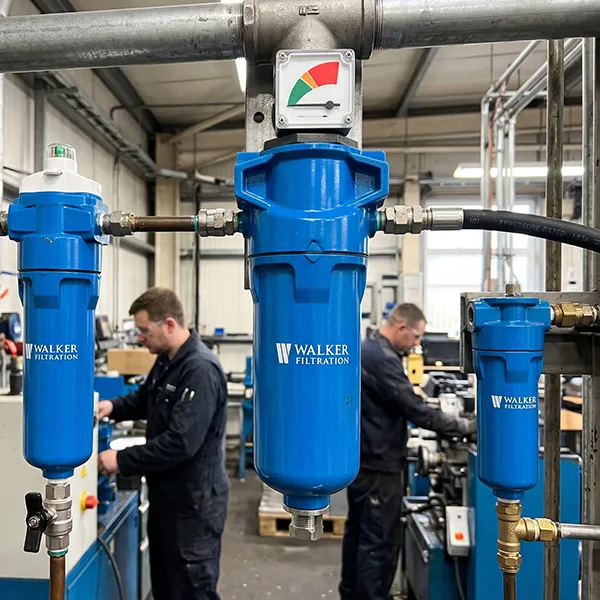
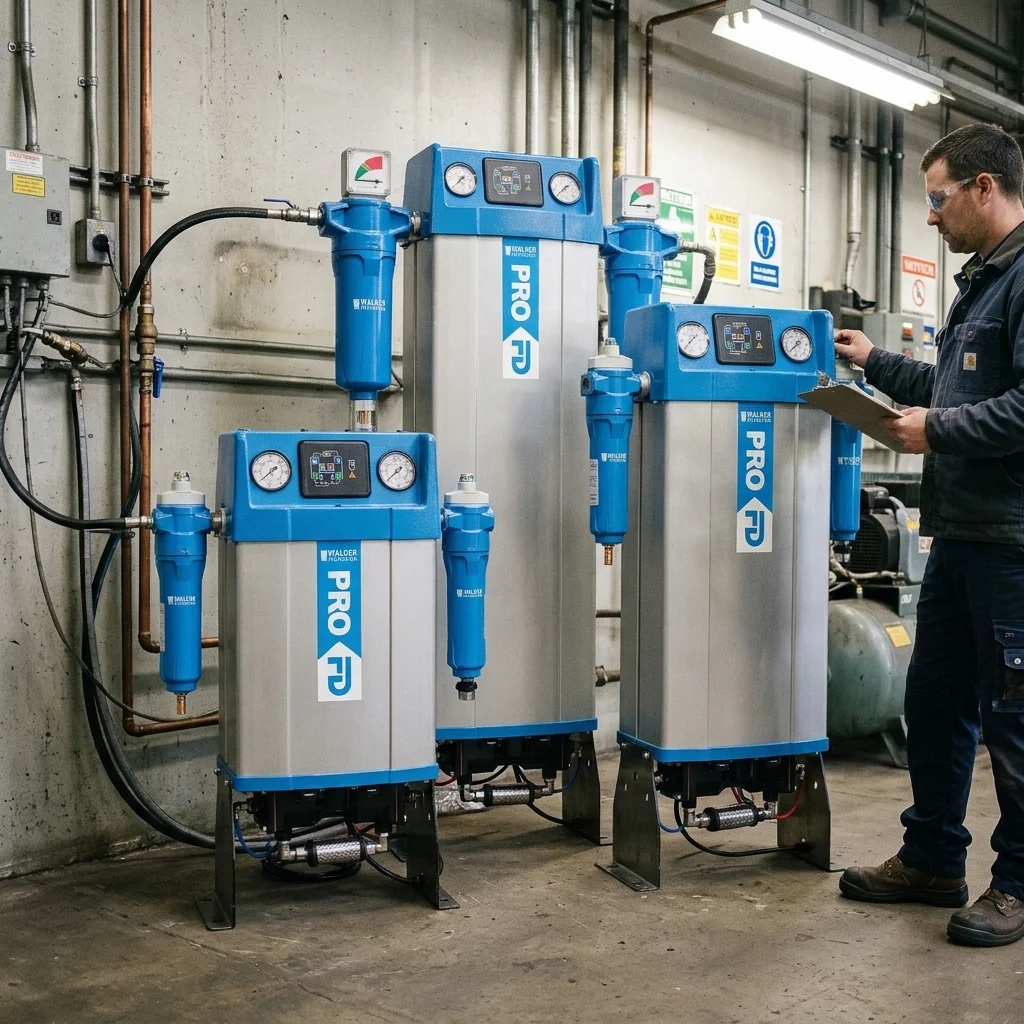
Each of the three numbers is set by a different piece of kit, which is why they move independently. The table maps the target to the equipment.
| Target | Set by | Typical equipment |
|---|---|---|
| Water Class 4 (+3C) | Refrigerant dryer | Standard refrigerant air dryer |
| Water Class 2 (-40C) | Desiccant dryer | Adsorption (desiccant) dryer |
| Water Class 1 (-70C) | Desiccant dryer | Adsorption dryer, deep drying |
| Oil Class 1 (0.01 mg/m3) | Coalescing filters | High-efficiency coalescing filter(s) |
| Oil Class 0 / vapour removal | Activated carbon | Carbon tower after coalescing |
| Particle Class 1 | Particulate / coalescing filters | Final particulate filter at point of use |
Each class is set by a different stage. A dryer fixes water; coalescing and carbon fix oil; final filters fix particles.
What air quality does my application need?
Match the class to the process, not to a general idea of clean. The table maps common applications to a widely used target.
| Application | Typical target class (P.W.O) |
|---|---|
| General workshop tools and actuators | 4.4.4 |
| Spray painting and powder coating | 3.4.3 |
| Food and beverage contact (general) | 2.2.1 or better |
| Pharmaceutical and sterile processes | 1.2.1 or better |
| Electronics and instrumentation | 1.2.1 |
| Breathing air | Governed separately by EN 12021, not ISO 8573-1 |
Common application targets. Always confirm against the equipment maker and process requirement.
Over-specifying costs money too. Deep desiccant drying and carbon towers add capital, pressure drop and energy; if the process only needs Class 4 water, Class 1 is paid for and never used.
How do I verify a class, and where?
A specification is only real if it is measured, and where it is measured matters as much as the number. Pipework, dead legs and point-of-use fittings re-introduce water and particles after the dryer and filters, so air that is Class 1.2.1 at the plant can be far worse at the tool.
- Set the target class for each of particles, water and oil from the process requirement.
- Specify drying and filtration to meet each, in the right order, dryer then coalescing then final filter.
- Measure at the point of use, not just at the compressor, for dew point, oil and particles.
- Record the measured class and the date so it can be trended and audited.
Frequently asked questions
What does ISO 8573-1 Class 1.4.1 mean?
It means Class 1 for particles, Class 4 for water and Class 1 for oil. Class 4 water is a pressure dew point of +3C, and Class 1 oil is a maximum total oil content of 0.01 mg/m3. The three numbers are read in the order particles, water, oil.What order are the ISO 8573-1 classes written in?
Always particles first, then water, then oil. So in 1.4.1 the particle class is 1, the water class is 4 and the oil class is 1. A lower number is cleaner in every column.What is ISO 8573-1 Class 2 water?
Class 2 water corresponds to a pressure dew point of -40C, achieved with a desiccant (adsorption) dryer. Class 4 water of +3C is achieved with a standard refrigerant dryer, so the water class largely tells you which type of dryer is fitted.What is ISO 8573-1 Class 0?
Class 0 is cleaner than Class 1, with the exact limit agreed between supplier and user and documented. It suits the most sensitive processes such as pharmaceutical and food contact, but only means something if the agreed value is written down; it is not a generic term for oil-free.How do you achieve Class 1 oil?
Class 1 oil (0.01 mg/m3) is achieved with high-efficiency coalescing filters, usually in stages, and activated carbon is added where oil vapour must also be removed for the cleanest grades. Oil class is set by filtration, independently of the dryer.Is breathing air covered by ISO 8573-1?
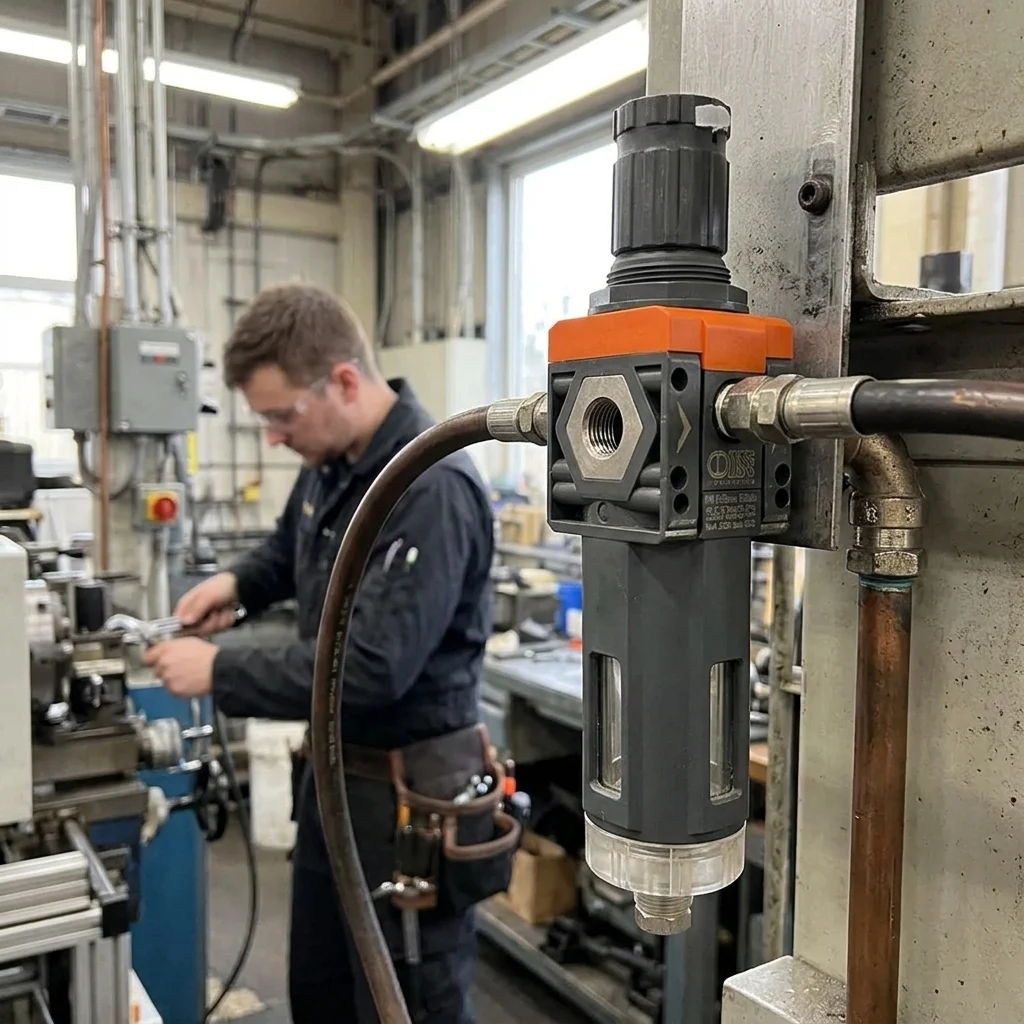
No. Breathing air quality is governed by EN 12021, not ISO 8573-1. ISO 8573-1 grades industrial compressed air purity for process use. Our compressed air treatment solutions include filters, regulators and lubricators designed to support reliable pneumatic system performance.
Need a specific air quality class?
Pneumatics Group can specify filtration and drying to hit your particle, water and oil targets. Explore our compressed air preparation equipment from Festo to protect pneumatic components.
Old Naas Rd, Bluebell, Dublin, D12 F1HR, Ireland